Esta postagem integra lista do verbete igualdade e equidade.
ponto de atenção (superado): Artigo e livro integram as referências de pelo menos um versão da NTL n.º 20.
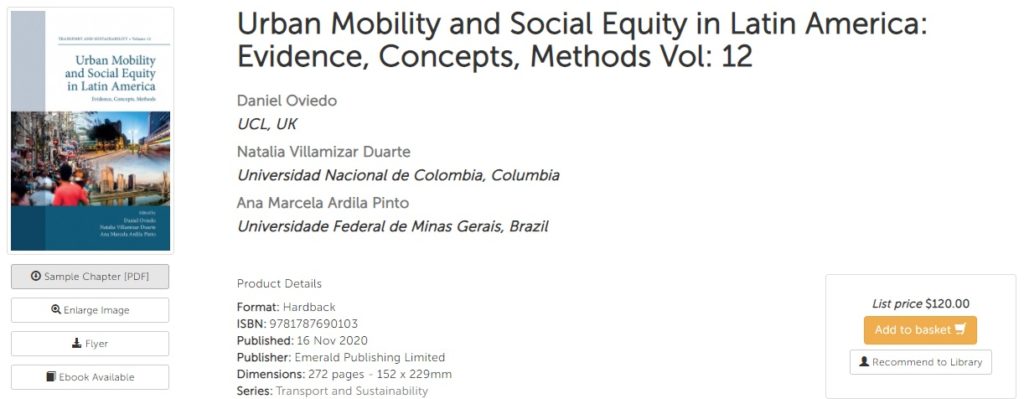
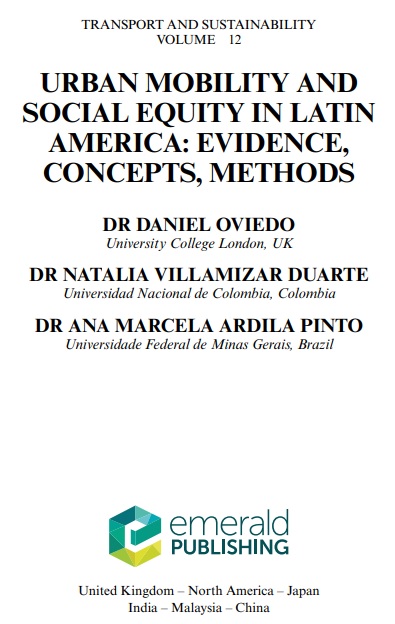
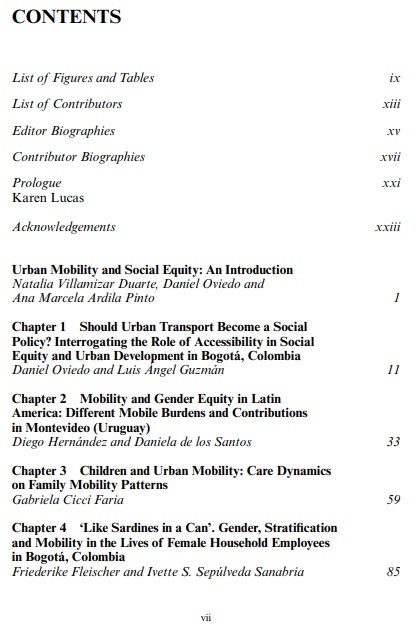
OVIEDO, D. et al (2020): OVIEDO, Daniel; DUARTE, Natalia Villamizar; PINTO, Ana Marcela Ardila (Ed.). Urban Mobility and Social Equity in Latin America: Evidence, Concepts, Methods. Bingley: Emerald. 2020. 400p.
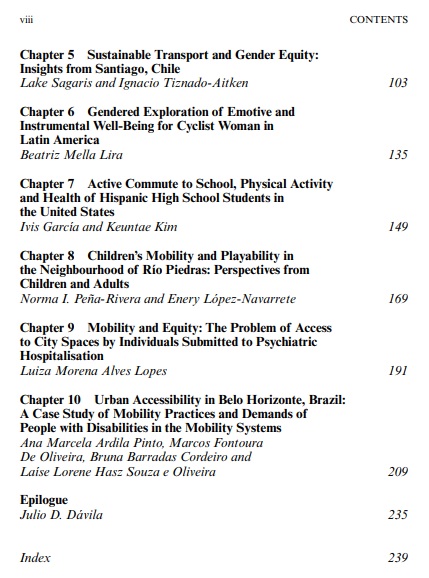
- PINTO. A.M.A; OLIVEIRA, M.F. et al (2020): PINTO, Ana Marcela Ardila; DE OLIVEIRA, Marcos Fontoura; CORDEIRO, Bruna Barradas; OLIVEIRA, Laíse Lorene Hasz Souza e. A Case Study of Mobility Practices and Demands of People with Disabilities in the Mobility Systems. In: OVIEDO, Daniel; DUARTE, Natalia Villamizar; PINTO, Ana Marcela Ardila (Ed.). Urban Mobility and Social Equity in Latin America: Evidence, Concepts, Methods. Bingley: Emerald. 2020. Chapter 10 – Urban Accessibility in Belo Horizonte, p.209-234. Disponível em: internet-PDF-Emerald. / internet-html-Emerald / internet-Levante-BH. Acesso em: 25 nov. 2020. [este capítulo de livro está lançado no Lattes MFO]

Live de lançamento (book launch) do livro em 25/02/2021.
Sobre o livro na internet (acesso em 19/08/2020):
Urban Mobility and Social Equity in Latin America: Evidence, Concepts, Methods
Daniel Oviedo, Natalia Villamizar Duarte, Ana Ardila Pinto
[Bingley (Inglaterra/UK)] Emerald Publishing Limited, 16 de nov. de 2020 – 400 páginas.
This volume compiles contributions from international scholars on the social impacts of urban mobility and discussions on concepts and methods to examine the distributional effects of transport policies in Latin America.
Chapters discuss concepts and methods for explaining the distributional effects of transport policies and for exploring alternatives to ensure equity and non-discrimination in access for more inclusive cities. Recognizing the deep relationship between accessibility, equity and inclusion, the contributions in this book are collated in three sections: structural dimensions of accessibility, active travel and local accessibility, and accessibility of emerging mobilities. The book builds on a balanced collection of case studies and comparative perspectives that showcase territorial, economic, political and social drivers of urban mobility and the development of accessible and inclusive urban spaces in Latin American cities.
Sobre o lançamento do livro na internet em 16/11/2020 (acesso em 16/11/2020):
trecho do artigo (5. FINAL CONSIDERATIONS):
Both the academic literature and the demands of the citizens are challenging traditional views of disability. Far from being only a problem of physical accessibility to urban space or transport systems, the practices, experiences and representations of mobility of people with disabilities are part of a broader process of everyday life construction in the cities and of claiming rights to equality from the perspective of diversity. In Belo Horizonte, the technical devices and regulatory instruments have advanced significantly, but remain anchored in dichotomous, homogenising, abstract and extremely synthetic visions that pin identities and contribute to deepening the stigmas attached to these groups.
While recent regulatory instruments have introduced universal design as a guiding principle, these changes have not been enough to modify the city’s mobility planning and management processes. Public spaces and transportation systems systematically contribute to increasing the exclusion of the population with disabilities, both by the quality and quantity of available physical devices and by the service of the employees. Meanwhile, the population’s needs are diverse, both in terms of disability situations, as well as the spaces and agents involved in travelling practices. The urban space plays a key role in imposing barriers to travel at multiple scales.
Additionally, most people with disabilities in the city face high levels of immobility, as well as difficulties in accessing the city’s goods and services, especially the services related to health, education and work. The high levels of illiteracy, unemployment and low-income contrast with the high dependence of people with disabilities on public transport and medical services. Thus, the urban space contributes to the intensification of the exclusion of these citizens, especially of the youngest and the poorest in the city. Therefore, the conditions of people with disabilities present a great accumulation of barriers and restrictions in a city that excludes and segregates its population from access to urban goods and services.
Public spaces for walking and public transport are vital to ensure the rights of both this particular group and the general population. However, the dynamics of urban management in these spaces create barriers that prevent their proper use, especially for people with disabilities. The city’s transport system is deficient in ramps, turnstiles and adapted stations, as well as in enough information systems to guarantee universal, autonomous and free access for people with disabilities.
The organisational structure of the city’s transport system, based on the concession system, with low enforcement capacity, does not offer technological devices nor a sufficient number of qualified employees to include people with disabilities as legitimate users of the system. From the perspective of the participants of the focus group, public policy and urban governance are based on a homogenising vision of citizens that treats them as universal, average users, without particular needs and demands. Special assistance depends on street level bureaucrats, who have high levels of administrative discretion and shape the daily experience of people with disabilities.
Furthermore, public space management is characterised by high dispersion and individualisation in the production of areas suitable for pedestrians in terms of quality and quantity. Sidewalks, ramps and other circulation areas are extremely heterogeneous and hinder a possibility of autonomous and safe use. In view of the lack of provision of adequate spaces and transport systems, the demands of the population with disabilities are varied and require structural changes in urban planning, in provision of public services and transport, as well as in the attitudes of citizens. The universal design, therefore, requires a broader and more complex application, especially in Latin American countries, with their very poor transportation systems and precarious assistance services. Political mobilisation and the creation of scenarios of participation of the citizens can contribute to the production of more diverse and democratic views on urban life.
This analysis of the practices and demands of the people with disabilities in mobility systems, based on the analysis of quantitative and qualitative methods, constitutes one of the primary efforts made in the city to acknowledge the barriers and challenges that citizens face daily to access urban transport and public spaces in the city, thus exercising their right to mobility. Some of the results show continuity of the situation in other cities. However, we have observed significant differences in regard to the forms of urban management, especially with respect to the public transport sector and to the production of public spaces.
Being a recent concern in the academic studies of the city, there is still the need to go deeper into key aspects such as the inclusion of the theme accessibility for the population with disabilities in normative instruments and in the implementation of local policies. We should particularly advance in the identification of barriers in the different transport modes, as well as in different areas of the city, with different morphological characteristics, use and activity distribution and transport availability. It is also necessary to further explore the organisation forms of this social group and the strategies employed to discuss their demands in the public sphere. Last but not least, it is also fundamental to advance in the understanding of the people’s strategies, desires and expectations that challenge our notions of normality and justice with their diverse forms of appropriating and using the city.